
The House Is the Hardest Part of Your Divorce
You know the math matters — but no one is showing you the math.
Your attorney charges $300+ per hour and still cannot tell you whether you will qualify to carry the mortgage alone. Free court forms ask you to write a number in the "equity" box but never explain how to calculate it. Your real estate agent wants to list the property yesterday. Your mediator needs you to arrive with a proposal — but you do not have one because nobody has explained the actual options.
Meanwhile, every week you delay costs you carrying expenses on a home that might not even be yours in six months.
The Divorce Property Navigator
This is a process-navigation guide for the single most expensive decision in your divorce: what happens to the house.
It does not replace your lawyer. It replaces the hours of expensive legal education you would otherwise pay for at $300–$500 per hour — the basic mortgage math, the equity calculations, the refinancing criteria, the settlement language. You do the prep work at home for a fraction of a single billable hour, then walk into your attorney's office with a clear strategy and completed worksheets.
The financial mechanics covered here — home valuation, equity splits, debt-to-income ratios, refinancing qualification, mortgage assumption rules — are governed by federal banking guidelines that work the same way in every state and country. The guide flags exactly where your local laws diverge so you know what to verify.
What You Get — 10 PDFs
Complete 13-Chapter Guide
The full process-navigation guide covering title vs. mortgage distinctions, equity calculations, refinancing mechanics, tax implications across eight jurisdictions, settlement language, asset offsetting, co-ownership structures, and post-decree enforcement.
Equity Calculation Worksheets
Five fillable worksheets: Net Equity and Buyout Ledger, Separate Property Tracing, Refinance Feasibility Self-Assessment, Mortgage Assumption vs. Refinance Comparison, and Document Collection Checklist. Print and fill in before your next attorney meeting.
Four-Option Decision Matrix
A structured comparison of selling, buying out, assuming the mortgage, and co-owning — scored across financial risk, credit exposure, tax triggers, timeline, and child stability. Includes a scoring sheet so you can rank each option for your situation.
Settlement Clause Templates
Five ready-to-adapt clauses: Equity Buyout and Refinance Deadline, Fallback Sale Trigger, Carrying Costs During Transition, Indemnification of Departing Spouse, and Deferred Sale Terms. Hand these to your attorney instead of paying them to draft from scratch.
Co-Ownership Agreement Planner
For couples who cannot sell yet — structured terms for monthly cost splits, maintenance responsibilities, sale triggers, right of first refusal, default provisions, and credit monitoring.
Post-Decree Execution Checklist
Timeline of every action required after the judge signs the decree — from updating tax withholding within 10 days through title transfer and tax filings within 6 months.
Five-Phase Timeline
Maps your entire real estate process from pre-filing diagnostics through conveyancing and title transfer — with checklists and contingency deadlines at each phase.
Cross-Jurisdictional Tax Reference
Capital gains exclusions, transfer tax rules, and filing deadlines for the US, Canada, UK, Australia, Ireland, New Zealand, South Africa, and Singapore. Includes a critical filing deadlines table.
Safety & Communication Scripts
Ready-to-use email templates for requesting mortgage statements, scheduling appraisals, following up on refinance deadlines, and addressing missed payments. Plus safety resources and enforcement steps when a spouse refuses to cooperate.
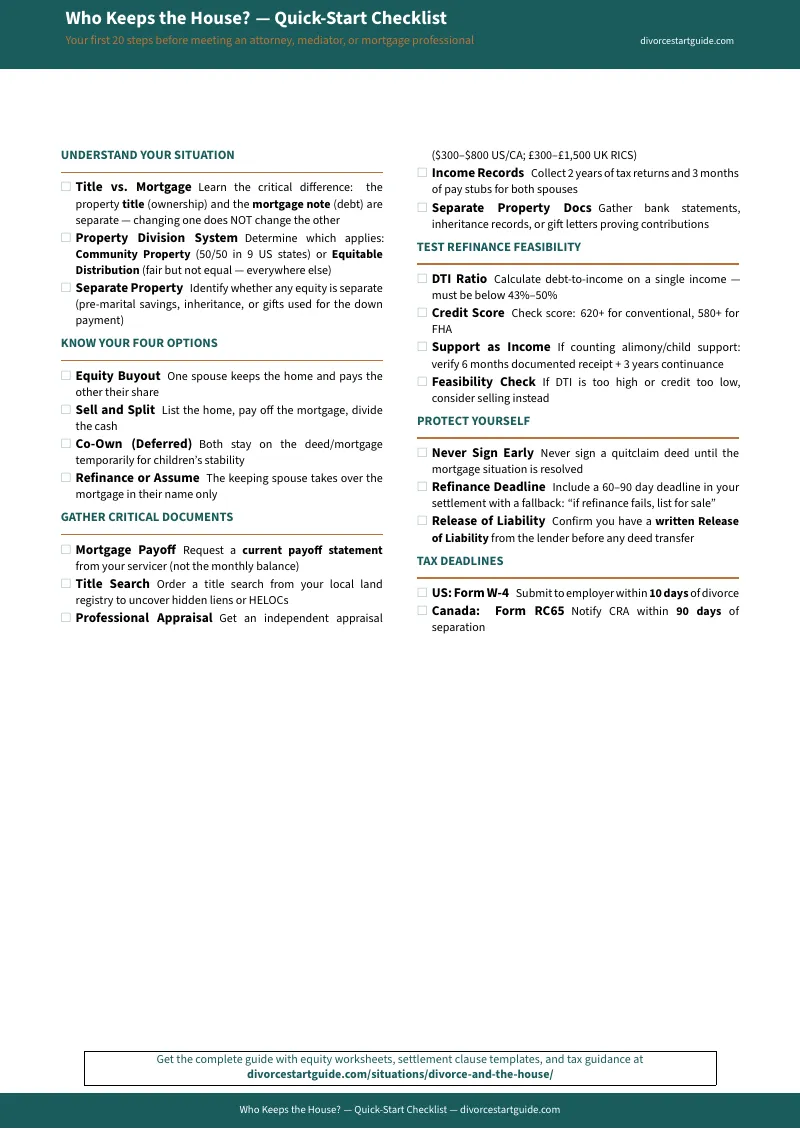
Quick-Start Checklist
A one-page action checklist with 20 items to work through sequentially — the free download that shows you the structure of the full guide.
Who This Is For
- Divorcing couples who own a home and need to decide what to do with it
- The spouse who wants to keep the house but is not sure they can qualify for the mortgage alone
- Anyone in mediation who needs to arrive with a completed equity calculation and a clear proposal
- People whose ex is refusing to cooperate on selling or refinancing the home
- Anyone who wants to cut their legal bill by doing the financial prep before the attorney appointment
Why Not Use Free Resources?
Free court self-help pages give you blank forms and zero strategy. They tell you where to write a number but never how to calculate it, what the downstream mortgage implications are, or whether the number you chose will actually survive your lender's underwriting review.
Generic real estate articles say "just get an appraisal and split it" — ignoring separate property tracing, marital debt offsets, capital gains timing, and the fact that equity on paper means nothing if you cannot qualify for the refinance to actually execute the buyout.
Attorney consultations at $300–$500 per hour are essential for legal advice — but expensive for basic financial education. This guide handles the education so your attorney time goes toward strategy.
Satisfaction Guarantee
If the guide does not give you a clearer picture of your options and the math behind each one, email us and we will refund you immediately. No forms, no waiting period.
— Less Than 10 Minutes of Attorney Time
A single attorney hour costs $300 to $500. This guide replaces several of those hours of basic financial education — the equity math, the refinancing criteria, the settlement language — for less than you would spend on parking at the courthouse.
Download the free checklist to see the structure, or get the full guide with all worksheets, templates, and playbooks included.