The free forms exist. The instructions don't.
You've found the Uniform Domestic Relations Forms on the Ohio Supreme Court website. Maybe you've even printed them out. And now you're staring at a stack of blank pages with no indication of which ones apply to your situation, what order to complete them in, or which county-specific addenda your local Court of Common Pleas requires on top of the state-standard set.
You call the clerk's office. They tell you they are "legally prohibited from providing legal advice" and cannot review your paperwork for errors. You go online. Ohio Legal Help walks you through the general concepts, but it doesn't tell you whether your county requires single-sided printing, what ink colour the notarisation stamp must be, or what to do when your certified mail comes back unclaimed and your entire case stalls.
Meanwhile, a family law attorney in Ohio charges $230 per hour on average. A retainer starts around $2,000 for an uncontested case. If your divorce is truly cooperative and you're willing to do the administrative work, most of that retainer is paying for a paralegal to organise the same paperwork you could assemble yourself — if someone told you how.
The Ohio Filing Sequence System
This is a complete, step-by-step guide to filing for divorce or dissolution in Ohio without an attorney. It is not a form generator. It does not replace the free court forms. It is the Filing Sequence System — the chronological, county-aware workflow that tells you which forms to complete, in what order, how to format and assemble the packet, and what to do at every stage from residency verification through your final hearing.
Ohio is one of the few states that offers two entirely different legal tracks for ending a marriage: divorce (one spouse files, the other is served) and dissolution (both spouses petition jointly). The guide covers both tracks in full, including the conversion mechanics if your dissolution falls apart because one spouse fails to appear at the hearing.
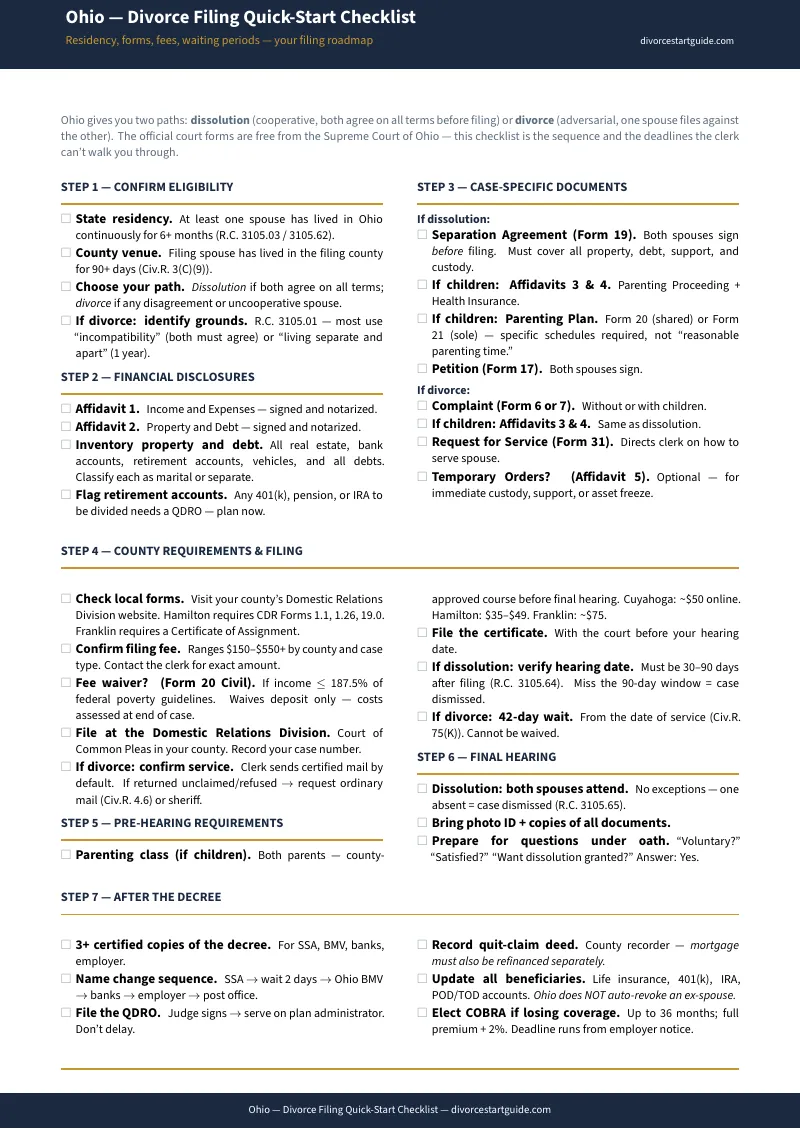
What's inside — the 12-chapter guide, 9 standalone worksheets, and the free checklist
- Divorce vs. Dissolution Decision Framework — a structured comparison of both legal tracks so you can choose before you download a single form. Because filing on the wrong track wastes your filing fee and costs you months.
- Residency & Venue Verification Checklist — the 6-month state residency rule, 90-day county residency rule, and how to handle the case when you and your spouse live in different counties. File in the wrong court and the clerk rejects your paperwork on the spot.
- Complete Form Assembly Sequence — Supreme Court forms plus county-specific addenda, in the exact order your courthouse expects to receive them. Includes formatting rules that trip up pro se filers: single- vs. double-sided printing, ink colour requirements, Confidential Disclosure of Personal Identifier sheets, and notarisation protocols.
- Service of Process Tracking System — certified mail logs, pre-written Instructions for Service templates for when delivery fails, and the escalation path from certified mail to ordinary mail to sheriff service to publication. Most pro se filers don't realise their case is stalled until months have passed — this system catches failures the week they happen.
- County Filing Fee Table & Fee Waiver Walkthrough — comparative fees across Ohio's major counties ($250–$475 range plus the mandatory $32 DV shelter surcharge) and step-by-step instructions for filing Supreme Court Form 20 if you qualify for a fee waiver under ORC 2323.311.
- Separation Agreement & Parenting Plan Templates — the structures your dissolution or divorce settlement must cover: property division, debt allocation, spousal support terms, and (if children are involved) Shared Parenting Plan requirements and mandatory parenting class deadlines by county.
- Equitable Distribution Inventory Worksheet — Ohio is an equitable distribution state, not a 50/50 state. This worksheet helps you build the asset-and-debt inventory the court expects, with separate columns for marital vs. separate property classification under ORC 3105.171.
- QDRO & Retirement Division Guide — when a Qualified Domestic Relations Order is needed, how to handle OPERS and STRS pensions, and the timing trap where filing the QDRO too late costs your share of interim investment gains.
- Final Hearing Preparation — what to bring, what the magistrate will ask, how the testimony script works, and the critical difference between a divorce hearing (one spouse testifies) and a dissolution hearing (both spouses must appear under oath or the case is dismissed).
- Dissolution-to-Divorce Conversion — the emergency pivot if your joint dissolution fails because your spouse does not show up. Step-by-step instructions for converting to a divorce action without paying a second filing fee or losing your original filing date.
Who this is for
The person sitting in a courthouse parking lot after the clerk just rejected their paperwork for the second time. The couple who agree on everything but cannot afford $4,000 in combined retainers for two attorneys to paper a deal they've already made. The spouse whose certified mail came back unclaimed three weeks ago and has no idea what to do next. The parent who just learned about the mandatory parenting class requirement and doesn't know whether they need to complete it before or after filing. And the person who tried an online platform, paid $300, and got back a generic form packet that didn't include a single county-specific addendum.
Why not just use the free resources?
Because the free resources give you forms, not sequence. The Ohio Supreme Court provides the Uniform Domestic Relations Forms — blank pages with legal headings. Ohio Legal Help provides general overviews and a document assembly tool that generates a standard packet. Neither one tells you what order to file in, which county-specific forms to add, how to track certified mail delivery, what to do when service fails, or how to prepare for the testimony at your final hearing.
The national platforms — 3StepDivorce at $299, LegalZoom starting at $499 — generate form packets from questionnaires. They handle the document assembly. But they don't cover the courthouse filing sequence, they don't tell you about your county's specific formatting rules, and they don't help you when your case stalls because of a failed service attempt. You're paying for documents. You need process navigation.
An honest guarantee
Work through the Filing Sequence System. If the guide doesn't give you a clearer, more organised path through the Ohio courthouse process than any free form packet or general overview could — email us within 30 days for a full refund. The risk of trying it is a fraction of one attorney billable hour. The risk of filing blind is months of delays, rejected paperwork, and trips back to the courthouse.
For — less than fifteen minutes of attorney time — you get the complete filing sequence, the service tracking system, the county fee table, and every worksheet and template the free forms leave out.
Stop guessing at the sequence. Get the guide, assemble your packet, and file it right the first time.